In traditional finance, we rely heavily on optimization techniques for portfolio construction, risk management, and regulatory calculations. However, many of these problems live in complex, non-convex landscapes where classical methods frequently fail to find the true global optimum.
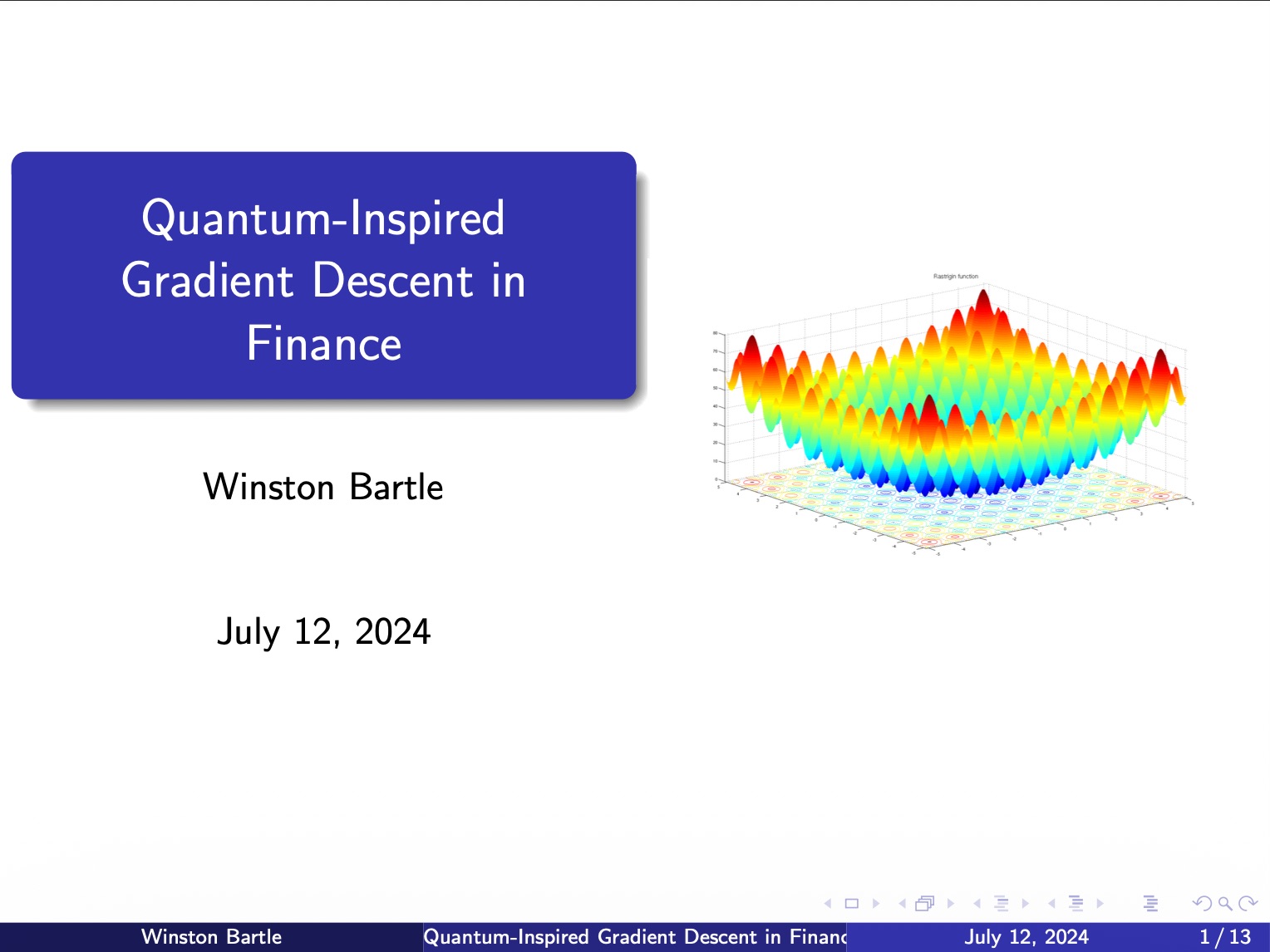
This is a well-known limitation. Methods based on mathematical derivatives, such as gradient descent, perform well on convex problems but struggle significantly when the loss surface contains many local minima.
Even Stochastic Gradient Descent (SGD), which introduces randomness to help escape local minima, can still fall short in highly multimodal or rugged optimization landscapes.
Enter Quantum-Inspired Gradient Descent (QIGD)
This is where Quantum-Inspired Gradient Descent (QIGD) becomes interesting.
QIGD is an optimization algorithm that enhances classical gradient descent by incorporating principles inspired by quantum computing — particularly superposition and amplitude amplification — without requiring actual quantum hardware.
By introducing quantum-inspired noise into the optimization process, QIGD can explore multiple potential solutions more effectively. This increases the probability of escaping local optima and converging toward better global solutions.
How It Works
At its core, QIGD mimics certain quantum behaviors:
- Superposition-inspired exploration: Instead of moving in a single direction, the algorithm maintains a distribution over possible update directions.
- Amplitude amplification-style noise: It uses carefully designed noise functions (inspired by quantum tunneling and amplitude amplification) to perturb the gradient steps.
- Probabilistic updates: This allows the optimizer to occasionally make moves that would be rejected by classical methods, helping it traverse difficult terrain.
The result is an optimizer that retains the efficiency of gradient-based methods while gaining some of the global search capabilities typically associated with evolutionary or swarm-based algorithms.
Why This Matters for Finance
Many critical problems in finance are inherently non-convex:
- Asset allocation under complex constraints and non-linear risk measures
- Risk model calibration (especially for behavioral models)
- IFRS 9 / CECL expected credit loss modeling, which often involves highly non-convex loss surfaces
- Stress testing and scenario optimization
In these domains, getting stuck in a local optimum can lead to materially suboptimal decisions — whether that's underestimating risk, holding inefficient portfolios, or producing inaccurate regulatory numbers.
QIGD offers a practical way to improve solution quality without abandoning the gradient-based paradigm that scales well to large problems.
Experimental Evidence
To test its effectiveness, I compared several methods on the classic Rastrigin function — a highly multimodal benchmark known for its large number of local minima:
- Classic Gradient Descent
- Stochastic Gradient Descent (SGD)
- Multiple variants of Quantum-Inspired Gradient Descent
The results were clear:
- Both Classic GD and standard SGD frequently became trapped in local minima.
- QIGD variants, particularly those using quantum amplitude and tunneling-inspired noise, consistently performed better at locating the global minimum.
This suggests that the quantum-inspired perturbation mechanisms provide a meaningful advantage in escaping the traps that plague conventional gradient methods.
Practical Considerations
QIGD is not a silver bullet, but it represents an elegant middle ground:
- It is much cheaper to run than true quantum optimization algorithms.
- It requires no specialized hardware.
- It can be implemented on top of existing PyTorch, JAX, or TensorFlow pipelines with relatively modest changes.
- It preserves the scalability advantages of gradient-based optimization.
For practitioners working on difficult financial optimization problems, it is a technique worth having in the toolbox.
Final Thoughts
Quantum-Inspired Gradient Descent is one of those ideas that bridges two worlds — the maturity of classical machine learning and the theoretical power of quantum computing.
While we may still be years away from fault-tolerant quantum computers capable of solving large-scale financial problems directly, techniques like QIGD let us borrow some of the useful ideas from quantum mechanics today.
I'm particularly excited about its potential applications in regulatory modeling and portfolio optimization, where even small improvements in finding better optima can translate into meaningful differences in risk metrics and capital requirements.
This is an area I'll continue exploring.